15 Hypothesis Testing in Multiple Regression
Reading. SW sec. 7.1, 7.3, HGL sec. 5.4–5.5
We now have Big Andy’s coefficients and their standard errors: \[ \widehat{\text{SALES}} = \underset{(6.35)}{118.91} \ \underset{(1.096)}{-\,7.908}\,\text{PRICE} \ \underset{(0.683)}{+\,1.863}\,\text{ADVERT}. \]
The good news is that the inference machinery is exactly what we built for simple regression in confidence intervals and hypothesis testing — the same \(t\)-statistic, the same logic, the same rejection rules. There is only one change: the degrees of freedom are now \(N-K\) instead of \(N-2\).
The new power that multiple regression gives us is the ability to test and estimate combinations of several coefficients at once — the kind of question a manager actually asks (“what happens if I cut price and raise advertising?”). This chapter covers \(t\)-tests and confidence intervals on a single coefficient (with \(\text{df}=N-K\)), estimating and testing linear combinations of coefficients, and the distinction between single and joint restrictions — a teaser for the \(F\)-test.
15.1 \(t\)-tests on a single coefficient
Under the multiple-regression assumptions MR1–MR6, each coefficient has a \(t\)-statistic with the same form as in simple regression.
\[ t = \frac{b_k - c}{\mathrm{se}(b_k)} \sim t_{(N-K)} \qquad\text{under } H_0:\beta_k = c . \] The only difference from simple regression is that the degrees of freedom are \(N-K\) — subtract one per estimated coefficient — rather than \(N-2\). For Big Andy’s model, \(N-K = 75 - 3 = 72\).
Everything else carries over unchanged: the rejection region is determined by the direction of the alternative \(H_1\) (\(>,<,\neq\)); the \(p\)-value rule is still “reject if \(p \le \alpha\)”; and we still say “reject” or “fail to reject,” never “accept.”
Tests of significance
The default test reported for each coefficient is \(H_0:\beta_k = 0\) against \(H_1:\beta_k\neq0\) — “does this variable matter, holding the others fixed?” With a two-tail critical value of \(t_c = t_{(0.975,\,72)} = 1.993\), we can run both significance tests for Big Andy directly from the printed output.
For price, \[
t = \frac{-7.908}{1.096} = -7.22,
\] and since \(|{-7.22}| > 1.993\) (with \(p \approx 0.000\)) we reject \(H_0\): sales depend on price. For advertising, \[
t = \frac{1.863}{0.683} = 2.73,
\] and \(2.73 > 1.993\) (with \(p = 0.008\)), so we again reject: sales depend on advertising. Both regressors are statistically significant. The \(t\)’s and \(p\)’s printed in the regression table are exactly these tests, computed automatically. Running the regression in R makes this concrete — the t value and Pr(>|t|) columns are the significance tests:
One-tail tests of economic hypotheses
The interesting questions are usually directional, and the rule of thumb is to put the conjecture you want to establish in the alternative \(H_1\). Two of Big Andy’s questions illustrate the point, and they use the one-tail critical value \(t_{(0.95,\,72)} = 1.666\).
The first asks whether demand is price-elastic, i.e. whether \(\beta_2 < 0\) is large enough in magnitude that a price cut raises revenue. We set \(H_0:\beta_2 \ge 0\) against \(H_1:\beta_2 < 0\) and compute \[ t = \frac{-7.908}{1.096} = -7.22 < -1.666 . \] We reject: demand is price-elastic, so a price cut raises revenue.
The second asks whether advertising is profitable, meaning each extra dollar of advertising returns more than a dollar in sales, \(\beta_3 > 1\). We set \(H_0:\beta_3 \le 1\) against \(H_1:\beta_3 > 1\) and compute \[ t = \frac{1.863 - 1}{0.683} = 1.26 < 1.666 . \] Here we fail to reject: the data cannot prove that advertising returns more than it costs.
The advertising case is the cautionary one. The point estimate \(b_3 = 1.86 > 1\) looks profitable, but once we account for its imprecision (\(\mathrm{se} = 0.68\)), the data cannot rule out \(\beta_3 \le 1\). Statistical significance is not the same as economic decisiveness, and a point estimate on its own is not evidence for a sharp claim.
15.2 Confidence intervals in multiple regression
Interval estimation is identical to what we did in confidence intervals, with the only change again being the degrees of freedom: \[ b_k \pm t_c\,\mathrm{se}(b_k), \qquad t_c = t_{(1-\alpha/2,\,N-K)} = t_{(0.975,\,72)} = 1.993 . \]
For the price coefficient \(\beta_2\), \[
-7.908 \pm 1.993\,(1.096) = [-10.09,\ -5.72].
\] In dollar terms, a $1 price cut raises mean revenue by between $5,723 and $10,093 (or, for a dime, $572–$1,009). This is a tight, useful interval. For the advertising coefficient \(\beta_3\), \[
1.863 \pm 1.993\,(0.683) = [0.50,\ 3.22].
\] This interval is wide: $1,000 of advertising could return as little as $501 (a loss) or over $3,000. The width reflects the large standard error \(\mathrm{se}(b_3)\). R’s confint() reproduces both intervals:
confint(fit)
#>                  2.5 %     97.5 %
#> (Intercept) 106.251852 131.575368
#> price       -10.092676  -5.723032
#> advert        0.500659   3.224510
Figure 15.1 shows the two intervals side by side. The width is the story: the advertising interval is much wider than the price interval, and that wide interval is the same imprecision that made the “\(\beta_3 > 1\)” test inconclusive.
Code
ci <- data.frame(
  coef = c("price", "advert"),
  est  = c(-7.908, 1.863),
  lo   = c(-10.09, 0.50),
  hi   = c(-5.72, 3.22)
)
ci$coef <- factor(ci$coef, levels = c("price", "advert"))
ggplot(ci, aes(est, coef)) +
  geom_vline(xintercept = 0, linetype = "dashed", color = ucla$gray) +
  geom_vline(xintercept = 1, linetype = "dotted", color = ucla$red) +
  geom_errorbarh(aes(xmin = lo, xmax = hi), height = 0.18,
                 color = ucla$blue, linewidth = 1) +
  geom_point(color = ucla$darkblue, size = 2.6) +
  labs(x = "coefficient value", y = NULL)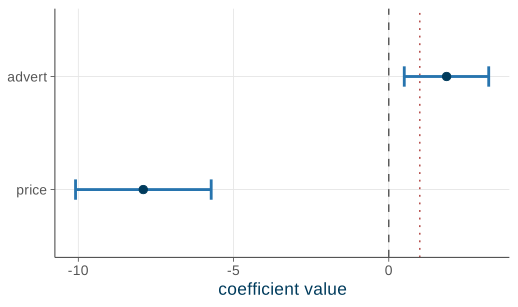
The remedy. The wide interval for \(\beta_3\) is a precision problem, and the fix is the one from variance and collinearity in multiple regression: more data, and more independent variation in advertising.
15.3 Linear combinations of coefficients
Real decisions move several regressors at once, so the natural quantity to estimate is a weighted sum of coefficients. Big Andy plans to drop price 40 cents and raise advertising $800 at the same time. The resulting change in expected sales is a linear combination of the coefficients: \[ \lambda = -0.4\,\beta_2 + 0.8\,\beta_3 . \]
Because the OLS estimator is BLUE, the corresponding combination of estimates, \(\hat\lambda = \sum_k c_k b_k\), is itself the best linear unbiased estimator of \(\lambda\), so the point estimate is immediate: \[ \hat\lambda = -0.4(-7.908) + 0.8(1.863) = 4.65 . \] Expected sales rise by about $4,653 from the combined strategy.
The standard error needs the covariances
To attach a standard error to \(\hat\lambda\) we need its variance, and the variance of a combination of several estimators carries a covariance term for every pair — this is the variance-of-a-sum rule from expectation, generalized: \[ \Var\!\Bigl(\sum_k c_k b_k\Bigr) = \sum_k c_k^2\,\Var(b_k) + 2\sum_{j<k} c_j c_k\,\Cov(b_j,b_k). \]
For \(\lambda = -0.4\,b_2 + 0.8\,b_3\), using Big Andy’s estimated variance–covariance matrix (\(\widehat{\Var}(b_2) = 1.201\), \(\widehat{\Var}(b_3) = 0.467\), \(\widehat{\Cov}(b_2,b_3) = -0.020\)), \[ \widehat{\Var}(\hat\lambda) = (-0.4)^2(1.201) + (0.8)^2(0.467) - 2(0.4)(0.8)(-0.020) = 0.504, \] so that \[ \mathrm{se}(\hat\lambda) = \sqrt{0.504} = 0.71 . \]
A 90% interval uses \(t_c = t_{(0.95,\,72)} = 1.666\): \[ 4.65 \pm 1.666\,(0.71) = [\,3.47,\ 5.84\,] \;\Rightarrow\; \$3{,}471 \text{ to } \$5{,}835 . \]
If you ignore the covariance term and add only the scaled variances, you get the standard error wrong. Here, because the covariance is negative and enters with a negative sign, omitting it would understate the spread of \(\hat\lambda\).
In R, the whole computation is a quadratic form in the estimated variance–covariance matrix, \(\widehat{\Var}(\hat\lambda) = c'\,\widehat{\Var}(b)\,c\):
cvec <- c(0, -0.4, 0.8)          # weights on (intercept, price, advert)
lam  <- sum(cvec * coef(fit))    # point estimate
vlam <- as.numeric(t(cvec) %*% vcov(fit) %*% cvec)
se   <- sqrt(vlam)
tc   <- qt(0.95, df = df.residual(fit))
c(estimate = lam, se = se, lo90 = lam - tc * se, hi90 = lam + tc * se)
#>  estimate        se      lo90      hi90
#> 4.6532091 0.7096133 3.4707851 5.8356332
Figure 15.2 places this interval on the dollar scale. The whole interval lies well above zero, so the combined strategy is very likely to raise sales — and even the pessimistic end, about $3,471, is a substantial gain.
Code
lc <- data.frame(est = 4.653, lo = 3.471, hi = 5.835, y = 1)
ggplot(lc, aes(est, y)) +
  geom_vline(xintercept = 0, linetype = "dashed", color = ucla$gray) +
  geom_errorbarh(aes(xmin = lo, xmax = hi), height = 0.12,
                 color = ucla$blue, linewidth = 1) +
  geom_point(color = ucla$darkblue, size = 3) +
  annotate("text", x = 4.653, y = 1.18, label = "$4,653",
           color = ucla$darkblue, size = 3.4) +
  scale_x_continuous(limits = c(0, 6.5)) +
  scale_y_continuous(limits = c(0.7, 1.3), breaks = NULL) +
  labs(x = expression(hat(lambda)), y = NULL)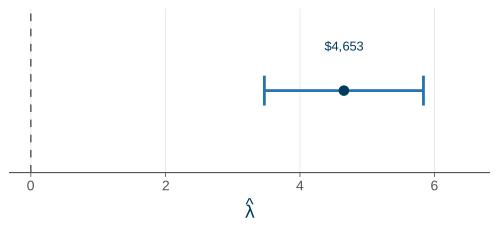
Testing a linear combination
To test a claim about a combination, use the same \(t\)-statistic with the combination’s standard error: \[ t = \frac{\sum_k c_k b_k - c_0}{\mathrm{se}\bigl(\sum_k c_k b_k\bigr)} \sim t_{(N-K)} . \]
There is also a slick algebraic shortcut that turns certain combination tests into ordinary single-coefficient tests.
To test, say, \(H_0:\beta_1 = \beta_2\) (two regressors have equal effects), rewrite the restriction as a single new coefficient \(\gamma = \beta_1 - \beta_2\) and re-specify the regression so that \(\gamma\) appears directly. The test is then an ordinary single-coefficient \(t\)-test on \(\hat\gamma\), and \(\hat\gamma \pm 1.96\,\mathrm{se}(\hat\gamma)\) is a confidence interval for the difference.
Either way — computing the combination’s standard error directly, or reparametrizing so the combination becomes one coefficient — a single restriction, even one that spans several coefficients, is always a \(t\)-test.
15.4 Single vs. joint restrictions
Everything in this chapter tests a single restriction: one equation about the \(\beta\)’s, even when that equation mixes several of them (as in \(-0.4\,\beta_2 + 0.8\,\beta_3\)). A single restriction is always a \(t\)-test.
A \(t\)-test cannot test several restrictions at once — a joint hypothesis such as \[ H_0:\ \beta_2 = 0 \ \text{ and } \ \beta_3 = 0 . \] Checking each restriction with its own \(t\)-test “one at a time” is unreliable, because the individual error rates compound and the joint significance level is no longer what you think. Testing joint hypotheses needs a new statistic: the \(F\)-test.
That joint machinery — overall significance of the regression, comparisons of nested models, and tests of economic restrictions like constant returns to scale — is the subject of \(F\)-tests.
15.5 Recap
Inference on a single coefficient in multiple regression is identical to simple regression, with the one change that the degrees of freedom are \(N-K\): \[ t = \frac{b_k - c}{\mathrm{se}(b_k)} \sim t_{(N-K)} . \] For Big Andy (\(N-K = 72\)), both price (\(t = -7.2\)) and advertising (\(t = 2.7\)) are significant; the one-tail tests show demand is elastic but cannot prove advertising is profitable (\(t = 1.26\)); and the confidence intervals are \(\beta_2 \in [-10.1,\,-5.7]\) and \(\beta_3 \in [0.50,\,3.22]\) (wide).
Multiple regression also lets us estimate and test linear combinations of coefficients. The estimator \(\hat\lambda = \sum_k c_k b_k\) is BLUE, its variance includes all the covariances between the estimates, and a single restriction — even one across several coefficients — is still a \(t\)-test. Big Andy’s combined price-and-advertising strategy is worth an estimated $4,653, with a 90% interval of \([\$3{,}471,\ \$5{,}835]\).
| What it tests | Tool | |
|---|---|---|
| Single restriction | one equation in the \(\beta\)’s (even across several) | \(t\)-test, \(\text{df}=N-K\) |
| Joint restriction | several equations at once | \(F\)-test |
To test several restrictions at once, we need the \(F\)-test, not a string of separate \(t\)-tests whose error rates compound.
Next time: interaction terms. So far each coefficient is a constant partial effect; with interactions (\(x_2 \times x_3\)) the effect of one variable depends on the level of another — and the marginal effects that result, like Andy’s optimal advertising, are exactly the combinations of coefficients we now know how to handle.