Code
| Component | Option 1 | Option 2 |
|---|---|---|
| Homework | 20% | 20% |
| Midterm | 30% | 40% |
| Final | 50% | 40% |
Reading. SW sec. 1.1–1.3, HGL sec. 1.1–1.5
Welcome to ECON 103. The goal of this course is to learn the core tool of empirical economics — linear regression — and how to use it with real data in R. Over six weeks we build a single idea in three stages: a probability review (the language of uncertainty), simple regression (one explanatory variable), and finally multiple regression (many explanatory variables, plus causality and treatment effects). This first chapter paints the big picture: what econometrics is, what it is for, and the single distinction that runs through the entire course — correlation vs. causation.
Before the economics, a few logistics. Lectures meet Tuesday and Thursday, 3:15–5:20 pm, and the paired lab meets Tuesday, 1:00–2:15 pm — both on Zoom, with recordings posted whenever technically possible. You must enroll in both the lecture and its paired lab. Office hours are Wednesday and Friday, 11:30–1:00, in Bunche 2265. Email the instructor at rlongmuir@g.ucla.edu with “ECON 103” in the subject line, and post questions to Campuswire (join code 6251), where the whole class benefits from the answer.
The main text is Principles of Econometrics by Hill, Griffiths & Lim (5th ed.); we cover roughly the first eight chapters, and the slides are posted as well. Stock & Watson is a useful second reference and is mapped chapter-by-chapter in the lecture notes. All the computing is done in R and RStudio, both free; install them before Lab 1 (campus and virtual desktops have them too). No prior coding experience is required.
The formal prerequisites are Econ 11 and Econ 41. We lean heavily on Econ 41 — the next three chapters refresh exactly the probability and statistics we need and nothing more.
Your grade is a weighted average of homework, the midterm, and the final, and we take whichever weighting is better for you. There are about four homework assignments, submitted online and due Mondays at midnight; late work earns half credit absent an accommodation or prior arrangement. Every assignment includes some coding questions (R recommended). The exams are multiple choice, online, and closed-book / closed-internet.
| Component | Option 1 | Option 2 |
|---|---|---|
| Homework | 20% | 20% |
| Midterm | 30% | 40% |
| Final | 50% | 40% |
The midterm is Thursday, August 20 and covers Lectures 1–10; the final is Thursday, September 10 and is cumulative.
Ask a half-dozen econometricians what econometrics is and you get a half-dozen answers: the science of testing theories; a toolkit for forecasting; fitting models to data; making numerical policy recommendations. They are all right.
Econometrics is the science and art of using economic theory and statistical methods to analyze economic data — to estimate relationships, test hypotheses, and predict outcomes.
Econometrics bridges the gap between being “a student of economics” and being a practicing economist. Theory tells you that “a price increase lowers quantity demanded.” Econometrics answers the question theory cannot: by how much.
Theory gives you the direction of a relationship, but real decisions need a number. Consider:
Each question is about a parameter — an unknown number (an elasticity, a slope, a multiplier) describing how one variable relates to another. The parameter’s value is unknown and must be estimated from data.
Because the answer comes from data, it carries uncertainty: a different sample gives a different number. For that reason we never report a bare estimate — we always report an estimate and a measure of how precise it is. Quantifying that precision is much of what the second half of the course is about.
Economic theory writes relationships as exact functions. A demand equation, for instance, might say that quantity demanded depends on the good’s own price \(P\), the price of a substitute \(P^s\), the price of a complement \(P^c\), and income: \[ Q^d = \beta_1 + \beta_2 P + \beta_3 P^s + \beta_4 P^c + \beta_5 \text{INC}. \] But real outcomes are not exact — countless small factors are omitted from any model. Econometrics confronts this by adding a random error \(e\): \[ Q^d = \underbrace{\beta_1 + \beta_2 P + \beta_3 P^s + \beta_4 P^c + \beta_5 \text{INC}}_{\text{systematic part (from theory)}} \;+\; \underbrace{e}_{\text{random ``noise''}}. \] The \(\beta\)’s are the unknown parameters we want to learn, and \(e\) collects everything we left out together with the intrinsic randomness of behavior.
This “systematic part \(+\) error” template is the skeleton of every model in the course. We meet it formally when we set up simple regression.
The same regression can serve different purposes — and the purpose changes what we must assume. It is worth being explicit about why we are building a model in the first place, because the answer determines how hard the job is.
Estimate the effect of \(X\) on \(Y\), holding all else equal: “How much do test scores rise because of smaller classes?”
Use \(X\) to make a good guess of \(Y\). Causality is not required here: “What will GDP growth be next year?”
Plug the estimates into a decision: “How much should the Fed raise rates? How much should we advertise?”
For prediction, you only need a stable association — a variable that reliably moves with \(Y\). For explanation and for sound decisions, you need the parameter to be causal, a much higher bar. Clearing that bar is most of the work of this course.
This is the central distinction of the course. Consider a regression of a student’s grade on the fraction of lectures they skip: \[ \text{GRADE} = \beta_1 + \beta_2\,\text{SKIP} + e . \] We expect \(\beta_2 < 0\): more skipping goes with lower grades. But does skipping cause low grades?
Maybe not. A demanding job, or low motivation, could drive both skipping and poor grades. In that case SKIP and GRADE are correlated — which is useful for prediction — yet \(\beta_2\) is not the causal effect of skipping. The slope also soaks up the influence of those omitted factors.
The lesson, repeated throughout the course: correlation is not causation. A good predictor need not be a cause. Umbrellas predict rain, but umbrellas don’t make it rain.
The gold standard for measuring a causal effect is a randomized experiment.
Split units into a treatment group and a control group by random assignment, then compare average outcomes between them.
Randomization makes the groups comparable in every other way, so the only systematic difference between them is the treatment. The causal effect is in fact defined as the difference such an experiment would reveal. Two classic illustrations: in agronomy, fertilize randomly chosen plots and compare yields; in education, Tennessee’s Project STAR randomly assigned students to small versus regular classes (we revisit it when we study treatment effects).
Real experiments are often unethical, infeasible, or too expensive. As a result most economic data are observational — we watch the world, we don’t run it.
When the data are observational, the danger is confounding: a third variable that drives both the treatment and the outcome.
Districts with small classes also tend to be wealthier. So a raw “small classes \(\to\) higher scores” comparison mixes the class-size effect with the income effect. Untangling the two is precisely the job of multiple regression in Part III.
Before modeling anything, it helps to know what kind of data we have. Economic data fall into three structural types:
Cutting across this classification, data are also experimental (generated by a designed experiment) or observational (surveys, administrative records) — and, as noted above, most economic data are observational. We start with, and spend most of the course on, cross-sectional data.
Our running example throughout the course (from Hill, Griffiths & Lim) is a cross-section of 40 households, recording each household’s weekly income (in hundreds of dollars) and weekly food expenditure (in dollars). The natural first look at the relationship between two variables is a scatterplot, shown in Figure 6.3.
Two things stand out. Higher income tends to go with higher food spending — the cloud of points slopes upward, and the correlation is about \(0.62\). But the points plainly do not lie on a line: at any given income, spending varies a great deal. That vertical scatter is exactly the random error \(e\) from our “systematic part \(+\) error” template.
data(food)
fit <- lm(food_exp ~ income, food)
ggplot(food, aes(income, food_exp)) +
  geom_point(color = ucla$darkblue, fill = ucla$blue,
             shape = 21, size = 1.8) +
  geom_abline(intercept = coef(fit)[1], slope = coef(fit)[2],
              color = ucla$red, linewidth = 1) +
  scale_x_continuous(limits = c(0, 35), breaks = c(0, 10, 20, 30)) +
  scale_y_continuous(limits = c(0, 620), breaks = c(0, 200, 400, 600)) +
  labs(x = "weekly income ($100s)", y = "weekly food exp. ($)")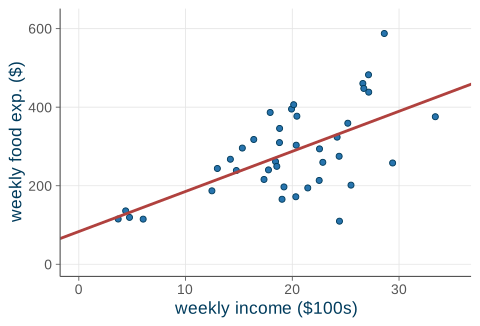
The OLS fit through this cloud is food_exp \(= 83.42 + 10.21 \times\) income: each extra $100 of weekly income is associated with about $10.21 of additional weekly food spending. Simple regression and OLS estimation make the idea of “draw the best line through this cloud” precise — that line is ordinary least squares.
Econometrics uses economic theory together with statistics to turn data into numbers: estimating parameters, testing hypotheses, and predicting outcomes. We organize that work around three goals and a small vocabulary of data structures.
| Three goals | Data types | |
|---|---|---|
| Explain | causal effects, holding all else equal | cross-section, time series, panel |
| Predict | a good forecast; causality not required | experimental vs. observational |
| Optimize | plug estimates into a decision / policy | most economic data are observational |
The big ideas to carry forward: every model is a systematic part \(+\) a random error \(e\); correlation \(\neq\) causation; and randomized experiments define causal effects, while with observational data we must work to approximate them.
Next time: the language of uncertainty — random variables and distributions.